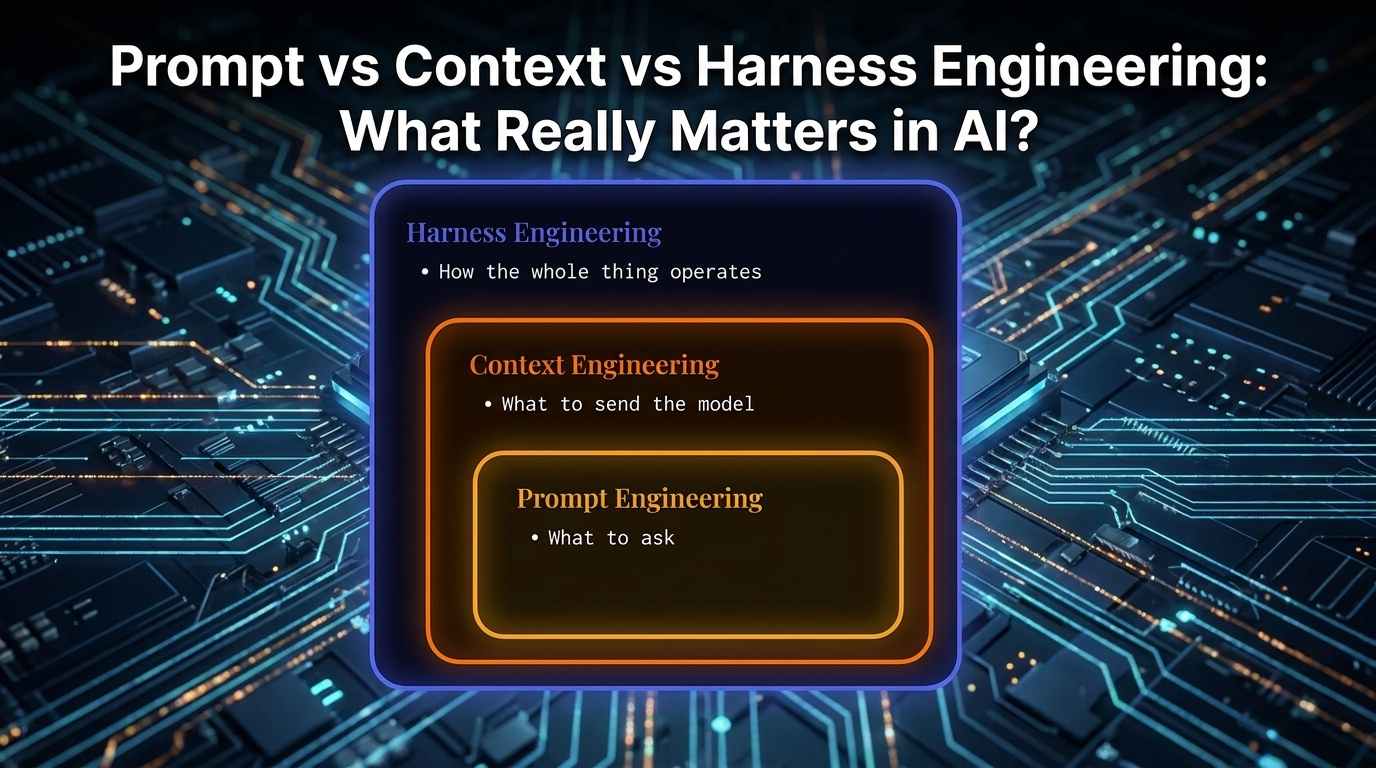
Prompt vs Context vs Harness Engineering: What Really Matters in AI?
I remember the first time I heard someone say "Harness Engineering" in a meeting. I nodded like I understood, then quietly Googled it on my phone under the table.
That was two weeks ago. Now I see this term everywhere—and honestly, most articles explain it in a way that makes it sound more complicated than it actually is.
Here's what I want you to know right up front: Prompt, Context, and Harness Engineering—these three concepts aren't competitors. They're teammates. They work together, and understanding how they differ will save you hours of frustration and make your AI projects actually work.
In this article, I'm going to break down each concept, explain how they fit together, and give you practical scenarios so you know exactly when to use each one. No fluff, no jargon—just what actually matters.
Let's get into it.
Content
- Why Everyone Is Talking About These 3 AI Concepts
- What Are Prompt Engineering, Context Engineering, and Harness Engineering?
- Prompt vs Context vs Harness Engineering: A Clear Comparison
- When Should You Use Each? (Real Scenarios)
- Tools That Support Prompt, Context, and Harness Engineering
- FAQs
- Conclusion
Why Everyone Is Talking About These 3 AI Concepts
If you've been working with AI Agents at all recently, you've probably noticed the conversation has shifted.
Back in 2023, everyone obsessed over Prompt Engineering—how to write the perfect instruction. Then around mid-2025, the buzzword became Context Engineering—understanding that what you feed the model matters just as much as the prompt itself. Now in 2026, everyone's talking about Harness Engineering.
Why does this keep evolving?
Because as AI models got smarter, we started using them for more complex, multi-step tasks. And we quickly learned that better prompts and better context aren't enough. The real challenge is building systems where AI Agents can operate reliably over time—catching their own mistakes, following consistent workflows, and actually delivering results you can trust.
That's what Harness Engineering solves.
What Are Prompt Engineering, Context Engineering, and Harness Engineering?
Let me break each one down with a simple analogy.
Prompt Engineering: What You Ask the Model
Prompt Engineering focuses on how you phrase your request to get a good output. It's the art of crafting instructions, examples, and constraints that guide the model's behavior in a single interaction.
Think of it like this: Prompt Engineering is like writing a clear brief to an employee. The better you explain what you need, the better they'll deliver.
What it handles:
- Word choice and structure
- Role-playing ("You are a senior software engineer...")
- Chain-of-thought reasoning
- Output formatting instructions
- Few-shot examples
Best for: Single tasks, one-off requests, simple interactions.
Common example:
Analyze this customer feedback and categorize it as positive,
negative, or neutral. Provide a brief summary "keyword">class="keyword">for each category.
Context Engineering: What the Model Sees
Context Engineering is about managing the information environment around each decision the model makes. This includes retrieved documents, conversation history, tool definitions, and any external knowledge you provide.
Think of it like this: Context Engineering is like making sure your employee has access to all the relevant files, emails, and background information before they start working.
What it handles:
- RAG (Retrieval-Augmented Generation) systems
- Conversation history management
- Tool definitions and instructions
- Memory systems (short-term and long-term)
- Information retrieval and summarization
Best for: Applications requiring knowledge from external sources, multi-turn conversations, complex decision-making.
Common example:
When a coding assistant needs to understand your entire codebase before making suggestions—that's context engineering at work.
Harness Engineering: The System Around the Model
Harness Engineering focuses on the operational infrastructure that surrounds an AI agent. It defines workflows, constraints, feedback loops, error recovery, and lifecycle management systems.
Think of it like this: If the model is the engine of a car, the harness is everything else—the steering, brakes, dashboard, seatbelts, and maintenance schedule. You can have the most powerful engine in the world, but without a proper harness, you won't get where you want to go.
What it handles:
- Workflow definitions and orchestration
- Error recovery and retry logic
- Permission systems and guardrails
- Validation and testing infrastructure
- Monitoring, logging, and feedback loops
- State management across long tasks
Best for: Complex AI agents, production systems, tasks requiring reliability and consistency.
Every time you discover an agent has made a mistake, you take the time to engineer a solution so that it can never make that mistake again.
Prompt vs Context vs Harness Engineering: A Clear Comparison
I know the differences can feel abstract. Let me make this concrete with a table and then walk through a real scenario.
Side-by-Side Comparison
| Aspect | Prompt Engineering | Context Engineering | Harness Engineering |
|---|---|---|---|
| Focus | What you say to the model | What the model sees when deciding | How the whole system operates |
| Scope | Single interaction | Information environment | Entire operational system |
| Analogy | Giving instructions to an employee | Providing reference materials | Designing the workspace and workflow |
| Best for | Simple, one-off tasks | Knowledge-intensive tasks | Complex, long-running agents |
| Key question | "How should I phrase this?" | "What should the model know?" | "How do I make this reliable?" |
A Real Scenario: Building a Customer Support Agent
Let me walk you through how all three work together.
Prompt Engineering: You write the system prompt that defines the agent's personality, tone, and response guidelines. You include instructions for handling angry customers and escalation protocols.
Context Engineering: You connect the agent to your knowledge base, product documentation, and customer history. When a customer asks about pricing, the agent can retrieve current information from your database.
Harness Engineering: You build in validation checks, rate limiting, cost controls, and human escalation triggers. You add logging so you can review conversations later. You set up monitoring so if the agent starts giving consistently bad answers, you get alerted.
All three layers working together = a customer support agent you can actually trust in production.
When Should You Use Each? (Real Scenarios)
Here's my practical framework for deciding which approach to focus on.
Use Prompt Engineering When:
- You're working on simple, single-step tasks
- You need quick experiments and prototypes
- The model has all the information it needs in one go
- You don't have complex requirements or constraints
Examples:
- Drafting an email
- Summarizing a document
- Generating ideas
- Simple translations
Use Context Engineering When:
- Your application needs external knowledge
- You're building multi-turn conversational systems
- The model needs to access specific, up-to-date information
- You're dealing with complex inputs that vary per request
Examples:
- RAG-powered chatbots
- Document Q&A systems
- Code assistants that read your codebase
- Any application with dynamic, retrieved information
Use Harness Engineering When:
- You're building production AI agents
- Tasks involve multiple steps, tools, or sub-agents
- Reliability and consistency are critical
- You need error recovery, monitoring, or approval workflows
Examples:
- Autonomous coding agents
- Research assistants that run multi-step investigations
- Workflow automation agents
- Any system that makes decisions or takes actions without human oversight
The Diagnostic Question
When something goes wrong, here's how to identify which layer needs attention:
- Output format or quality issues? → Prompt engineering
- Model doesn't have needed knowledge or retrieves wrong info? → Context engineering
- Agent drifts off task, makes repeated mistakes, or needs better error handling? → Harness engineering
Tools That Support Prompt, Context, and Harness Engineering
From my experience, most people overcomplicate this part. You don’t need a full stack of tools on day one—you just need to understand what each layer actually does and pick tools accordingly.
For Prompt Engineering
When I’m testing prompts, I usually keep it simple. Tools like ChatGPT, Claude, or Gemini are more than enough to iterate quickly and see what works.
If I need something more structured, I might look at frameworks like DSPy, but honestly, that’s only when I’m pushing toward automation.
For Context Engineering
This is where things start getting more “real-world.” When I need my AI to remember things or use external knowledge, I turn to vector databases like Pinecone or Weaviate, often combined with tools like LlamaIndex or LangChain.
That said, this is also where many setups become fragile. Managing memory, retrieval quality, and context limits takes more effort than most tutorials admit.
For Harness Engineering
This is the layer most articles skip—but it’s where things either work or break.
If I’m building multi-step workflows or agents, I might use frameworks like LangGraph or AutoGen. For more complex pipelines, tools like Temporal can help—but they also add serious complexity.
My Recommendation (Based on Real Use)
If I’m being honest, most people don’t need to touch half of these tools.
That’s exactly why I started using Nut Studio.
🚀 Nut Studio makes OpenClaw easy to deploy
Nut Studio lets you run OpenClaw with one click, no setup or coding required. Log in to enjoy 30 free points!
Instead of stitching together prompts, memory, and workflows manually, Nut Studio gives me a more integrated way to run AI agents—especially with local setups and built-in integrations. I don’t have to worry as much about wiring everything together or debugging fragile pipelines.
If you’re just getting started or you want something that actually works without spending days configuring tools, I’d recommend trying Nut Studio first—then only going deeper into custom stacks if you really need the control.
FAQs
Is Prompt Engineering still relevant in 2026?
Absolutely. While concepts like Context and Harness Engineering have gained attention, Prompt Engineering remains foundational. A well-crafted prompt is often the quickest way to improve outputs, and it directly affects how well context and harness systems perform.
Do I need all three for every project?
No. For simple, one-off tasks, Prompt Engineering alone is enough. For applications requiring external knowledge, add context engineering. Only for production AI agents handling complex, multi-step tasks do you typically need Harness Engineering.
Which one should I learn first?
Start with Prompt Engineering. It's the most accessible and provides immediate value. Once you're comfortable with that, explore Context Engineering if you need your AI to access external knowledge. Harness Engineering is more advanced and usually becomes relevant when you're building production systems.
What happens if I skip Eontext Engineering?
Your AI will likely hallucinate or provide outdated information. Context Engineering ensures your model has accurate, relevant information to work with—especially critical for enterprise applications.
How do I know if my harness is working?
Watch for these signs: fewer repeated mistakes, better task completion rates, more consistent outputs, and clearer feedback when things go wrong. If your agent keeps making the same errors, your harness needs improvement.
Conclusion
Here's what I want you to take away from this article: Prompt Engineering, Context Engineering, and Harness Engineering aren't competing approaches. They're complementary layers that work together to make AI systems reliable.
The key insight that changed my thinking: when your AI agent fails in production, the problem is almost never the model's intelligence. It's usually the harness—the system around the model. And unlike upgrading to a smarter model, improving your harness is something you can do right now with existing technology.
My recommendation: start with Prompt Engineering to get quick wins. Layer in Context Engineering when you need external knowledge. Invest in Harness Engineering when reliability matters and you're building production systems.
These aren't just technical concepts—they represent a fundamental shift in how we think about AI development. The question is no longer "how do I prompt better?" but "how do I design systems where AI can reliably do what I need?"
That's the real evolution, and understanding these three layers puts you ahead of the curve.